Qualification Matrix · HP Lessons 2
The Qualification Matrix: 3 Steps to High-Intent Deals
In my previous story, my CEO emphasized that:
Qualification and disqualification are the foremost important sales activities.
The "skinny sales funnel" is the key to a sales professional's success.
The core idea of a skinny sales funnel isn't about being “thin” or having “low volume.”
Instead, it refers to a funnel with a high concentration of prospects who are actively searching for, comparing, or ready to purchase a specific product or service. → A high intent density sales funnel.
The Criteria to Qualify a Lead
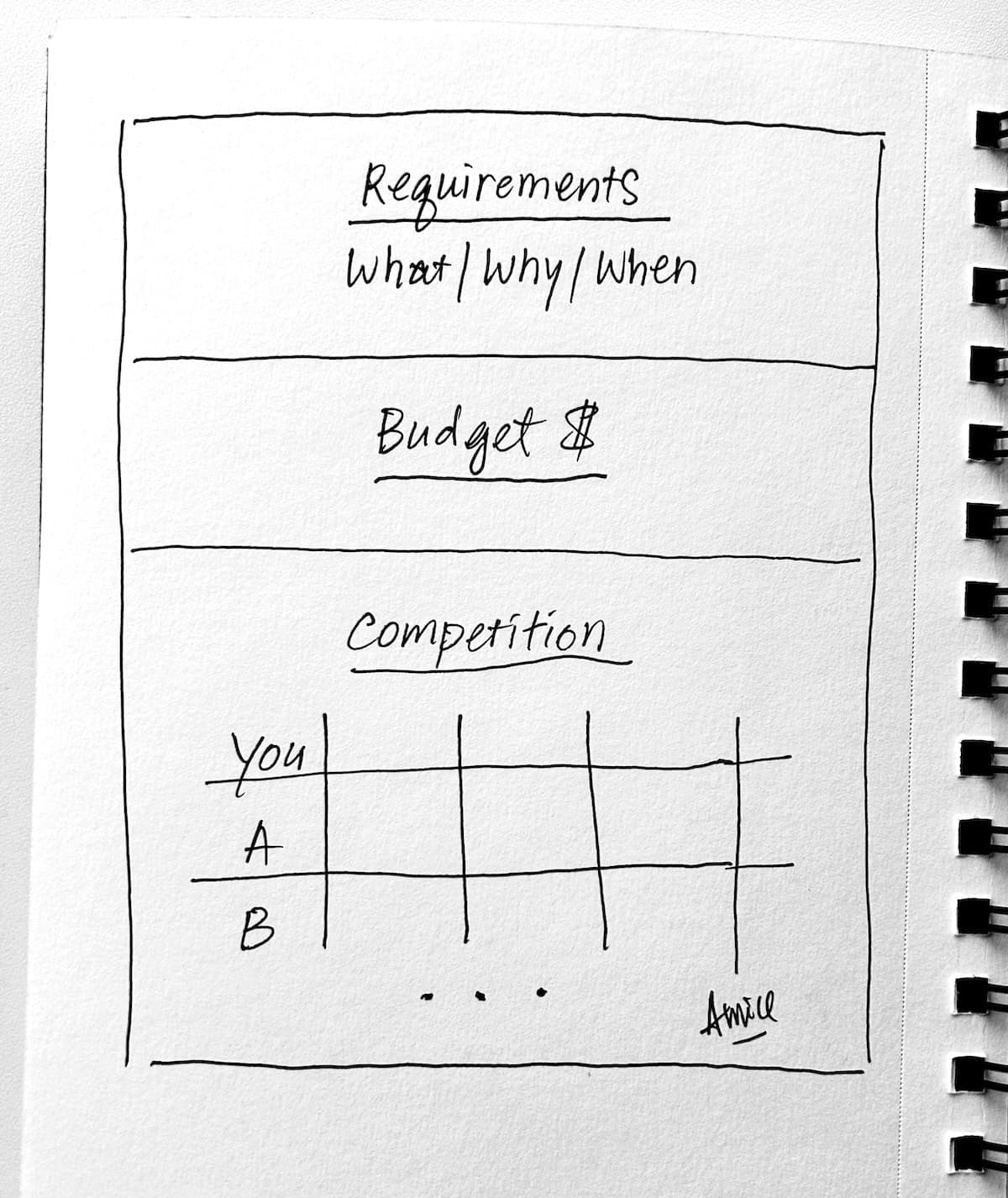
On another day, the CEO grabbed a piece of paper and drew two horizontal lines across it, saying, “These are the three keypoints to qualify your clients.”
This piece of paper (see my sketch below) became my sales checklist for my 20+ year sales journey (Sales rep at a startup → Account Manager at regional companies → Business Development Director at NTT and Verizon → Founder of my own software startup).
Let me show you this checklist, along with key points from my own experience.
- Example Client: A local financial institution.
- Solution Inquiry: Security solutions for their online transaction system (The “What”)..
1. Requirements — What / Why / When
Besides verifying the needs claimed by the client, we must also understand the agenda behind them. Why do they need your solution? What are the consequences if they fail to implement a solution? This means digging into the urgency of the client’s needs—the real buying signal.
In the later stages of the selling cycle, a sales rep should even highlight urgencies that the client hasn't thought of yet. But for this phase, let's focus on how to qualify a lead first.
In my case, the underlying intent or urgency (“Why” & “When”) could be:
- Regulatory requirements?
- A government deadline?
- Fulfilling a security audit?
- A recent security breach?
- KPI of decision maker?
- A top-down policy enforced by the group?
- Market benchmarking?
- Marketing purposes (e.g., promoting themselves as the #1 secure platform in HK)?
The goal is to understand the client’s readiness for change. Remember, there may be multiple reasons. Don’t stop digging just because you've discovered the first one.
2. Budget
Try to discover it by:
A. Just asking the client directly.
Tone: "Let my team design the most comprehensive solution tailored to your budget."
If you are a junior sales rep, like I was at the time, it is natural to feel awkward asking directly, “How much money do you have?”
B. Do NOT give up. Try a more indirect approach to know their expectations:
- "What is the expected cost for a project of this kind? My team has been doing some benchmarking recently."
- "By the way, what was the investment for your existing setup/projects of a similar scale?"
- Encourage them to give a range or a rough estimate instead of an exact number.
The information we need:
(1) Can the client afford your solution?
(2) Do they have an approved budget?
3. Competition
Analyze the following:
Who are the (possible) competitors? AND Compare:
- Your solution's technical strengths and weaknesses against their REQUIREMENTS (from part 1).
- "By the way, what was the investment for your existing setup/projects of a similar scale?"
- Encourage them to give a range or a rough estimate instead of an exact number.
If your solution lacks relative strengths (e.g., a specific feature or capability) in the areas the client requires, your chance of winning is very low. Disqualify it. This deal is not for you.
If your strength is something competitors lack, convince the client in the next stage of the cycle that this feature is the most critical factor for project success.
If your solution has a weakness while competitors are strong at that, it won't be an issue as long as that feature isn't part of their core requirements in (1). If the client asks about it, guide them to understand why that "weak feature" isn't crucial for their specific goal.
And then... there is a "Number 4" that most salespeople weight heavily, but I say NO. It should only be considered a "Nice to Have."
4. Relationship (Nice to Have)
Many believe that an existing relationship with the client is critical (referring to the personal relationship between the sales rep and the client). Of course, it’s perfect if you have worked with them before.
But what if you are a junior salesperson like I was? Then you must rely on how you score in the first three criteria. If your solution ranks much higher than your competitors', you are already on solid ground. Go for it even you are a stranger to the client today, for two reasons:
- You still have time to build a solid relationship with the decision-makers. Remember, you are a sales professional!
- Clients don’t buy complex B2B solutions just because they have a "good relationship" with a sales rep. Since you rank higher than your competitors in the core requirements, you strategically offer the strongest value. Clients purchase solutions that guarantee project success and protect their own job security. To them, your solution is the real gold mine. Your client will love you a lot!
Conclusion
Lead qualification becomes your greatest leverage when you:
- Have deep knowledge of both your products and your competitors' products.
- Stay frequently connected with your industry's trends.
- Qualify strictly based on criteria (1) to (3), not by ego or personal assumptions.
- Don't disqualify an account prematurely just because you lack initial information.
Let’s be frank: you rarely have a 100% solid analysis on Day 1, especially since uncovering the client's budget is somewhat difficult.
However, if you have the basics, i.e., client background, strong product knowledge, and the potential deal size is significant enough, invest your time in arranging a meeting to uncover the what you are not sure.
Be prepared for what you need to discover in your first meet up. And this was what my CEO's preferring as the “preparation” in my last sharing. Last but not least, be prepared to pivot to different scenarios based on the client's responses during the meeting.
I know Qualification is not an easy job, but it protects your time and confidence, compress the sales cycle, and, more importantly, drastically enhances your chance to win.
Follow My Journey
I am going to share more from my 20 years of enterprise sales experience, as well as the sales methodologies - the science of selling.
Please follow my journey here at Closmore.com, and my LinkedIn/Amice Wong.