Case Study · Furniture Bank GTM
Nonprofits Don't Have a Capacity Problem. They Have a GTM Problem.
What Furniture Bank's AI-forward hiring experiment reveals about pipeline thinking in the social sector
A case study by Closmore | closmore.com
The Post That Started This
In March 2026, Dan Kershaw — CEO of Furniture Bank, a Toronto-based social enterprise that has furnished over 67,000 homes for families in crisis — published an unusual hiring post on Substack.
He wasn't listing requirements. He was describing two organizational problems in operational detail, and asking if anyone knew how to solve them. The roles had no fixed job description. The first conversation was a 30-to-50-word DM, not a resume submission. Over 1,000 people read it the same day.
The follow-up post, published in April, was even more revealing. Of the candidates who responded, a clear pattern emerged. The strongest ones didn't talk about AI potential. They showed up with workflows — specific tools, timed production processes, pipelines they had already built. As Kershaw wrote: "Enthusiasm is not a skill. Curiosity is not a workflow."
The hiring process itself had become a signal.
But reading both posts from a B2B sales perspective, something else stood out: the problems Kershaw described aren't capacity problems. They're GTM problems.
What's in This Article
Case Study: Furniture Bank
Translating the Problem
Furniture Bank's stakeholder map reads like a B2B revenue org:
- Donors (furniture and cash) — the equivalent of customers. They have intake forms, CRM records, email sequences, and conversion events.
- Community partners (social workers, agencies) — the equivalent of channel partners or referral networks. They have a login portal, a referral pipeline, and an approval workflow.
- Corporate partners — enterprise accounts. They need a sales motion: a discovery conversation, a decision-maker video, a handoff to operations.
- Government bodies and sponsors — grant and funding relationships. They require reporting, relationship management, and renewal cycles.
- Families in need — the end beneficiaries. They don't have a direct intake path yet. Instead, they arrive through the partner referral layer.
The data to manage all of these relationships already exists. Furniture Bank runs Salesforce as its CRM, Typeform for community partner intake, Cognito Forms for donor pickups, Fundraise Up for AI-powered donations, Mailchimp for donor journeys, and a full Google Workspace. The intelligence is alive.
But as Kershaw described it: "Most of our team cannot get to it. Those who can, do so through manual processes that burn hours nobody has."
In B2B sales terms, this is a broken pipeline. The leads are in the system. The signals are there. Nobody can read them in time to act.
The Coordination Tax Is a Revenue Problem
Kershaw coined a phrase for this: the coordination tax — the hidden cost of information that exists but cannot be used.
In a for-profit GTM context, this has a direct revenue equivalent: deals that go cold because no one followed up, accounts that churned because the signal was buried in a spreadsheet, campaigns that ran to the wrong segment because the CRM wasn't clean.
For a nonprofit, the coordination tax compounds differently. A donor who gave three years ago and went quiet is a lapsed relationship. Nobody flagged the lapse because extracting that insight required a manual Salesforce query that nobody had time to run. A social worker trying to refer a family hits a form with no status update and refers elsewhere. A corporate partner considering a furniture diversion program waits three days for a call-back and picks a competitor liquidator instead.
Every one of these is a lost conversion. The sector just doesn't call it that.
What a Proper GTM Pipeline Looks Like for This Problem
This is where automation architecture becomes the argument.
The diagram below represents a POC built around three n8n pipelines, each mapping to one of Furniture Bank's core stakeholder flows, with a unified RAG layer on top for staff intelligence.
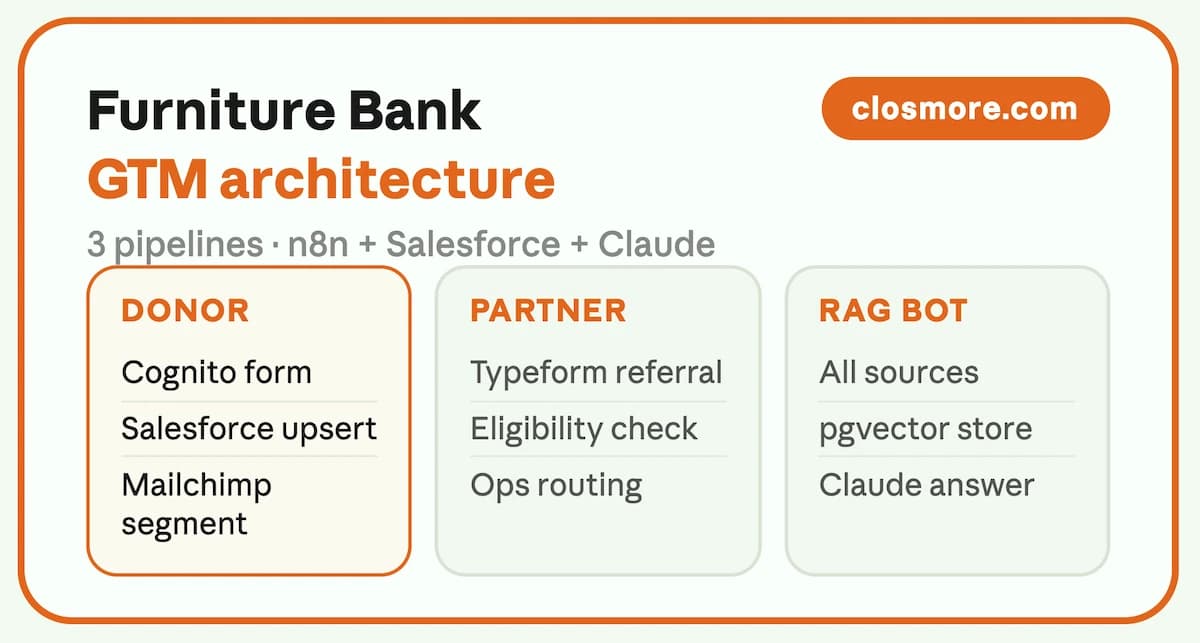
Automatic Pipeline 1 — Donor intake
Sources:
Cognito Forms (pickup requests, drop-off scheduling)
Flow:
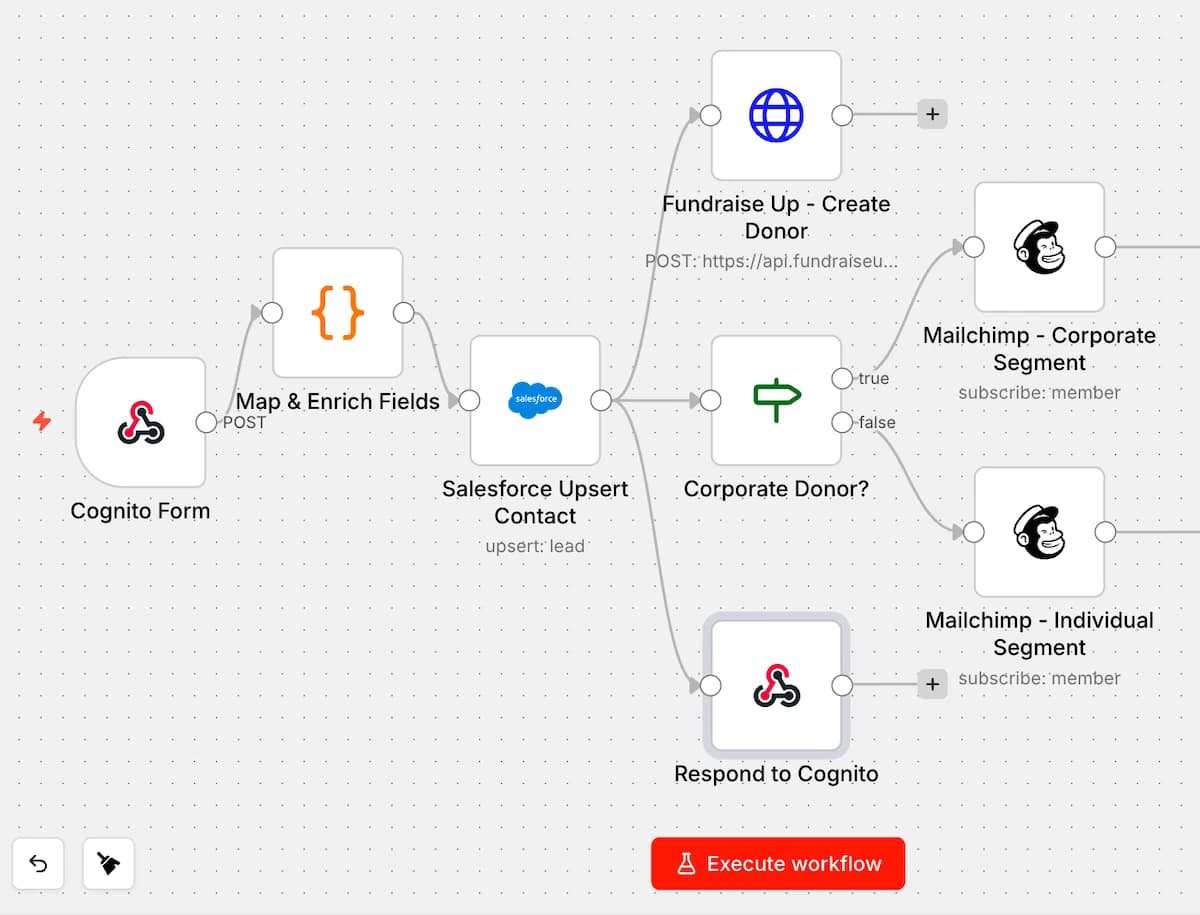
Form submission → n8n webhook trigger → field mapping and enrichment → Salesforce upsert → Fundraise Up donor journey → Mailchimp segmentation and send action
The outcome:
A donor who submits a pickup request is automatically profiled, matched to a segment, and entered into a follow-up journey — without a staff member touching the record. The signal from the form becomes a sales trigger.
In Closmore terms: this is qualification at the top of funnel. The form is the LinkedIn profile. The webhook is the signal capture. The Salesforce upsert is the pipeline entry.
Pipeline 2 — Partner referral
Sources:
Typeform (community partner login, family referral submission)
Flow:
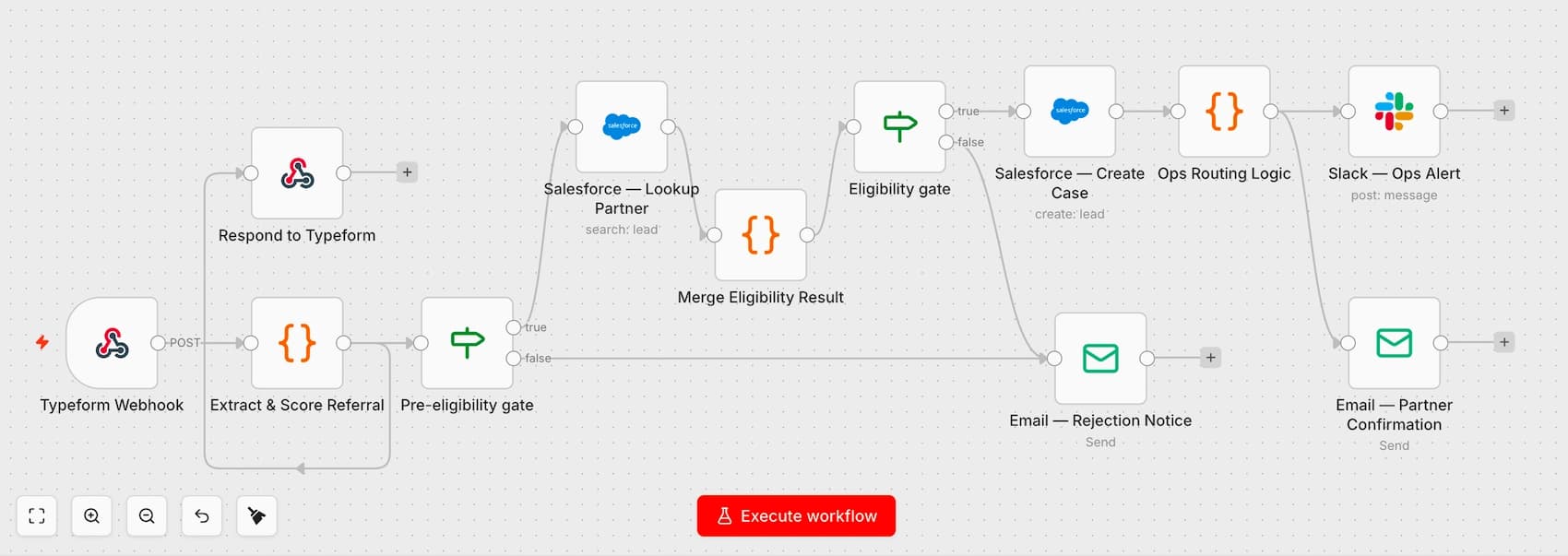
Referral submission → n8n trigger → eligibility rule check + Salesforce lookup → case creation → ops routing → partner + family notification
When it works, the referral pipeline maps cleanly onto a B2B channel partner motion:
Nonprofit step vs B2B equivalent
- Partner submits a referral vs Qualified lead enters pipeline
- Eligibility checked against criteria vs Qualification layer
- Case created in Salesforce vs Pipeline entry
- Operations routes to driver + schedule vs Fulfillment
- Partner and family get status update vs Relationship loop closed
What doesn't work:
When the referral lands in an inbox, sits for two days, and the social worker hears nothing. The partner refers elsewhere next time. The family waits longer. The relationship degrades.
This is churn. The nonprofit sector may just call it "business as usual".
Pipeline 2 (Partner) works like this:
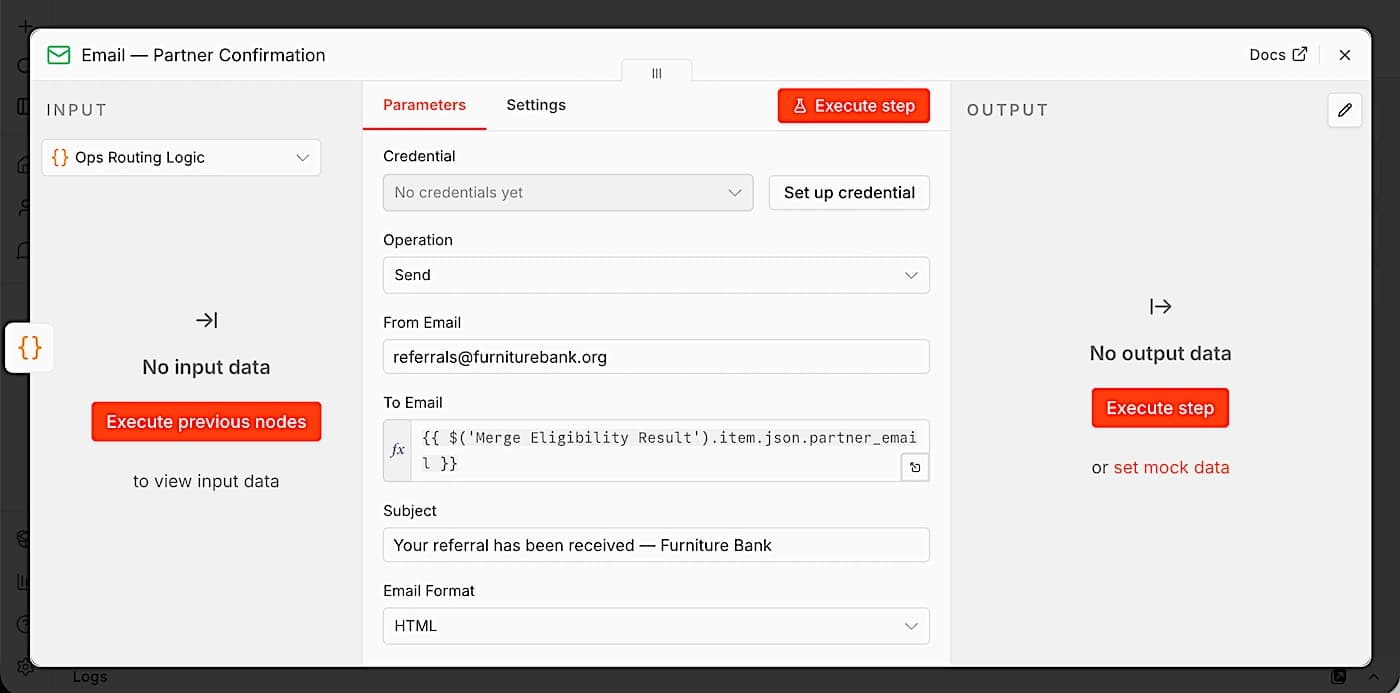
The n8n workflow triggers on every Typeform submission, runs an eligibility check against the partner's Salesforce approval status, creates the case automatically, routes it to the right operations team by postal code and urgency score, and sends a confirmation to the partner, all before anyone reads an email.
Referral velocity increases. Partner confidence increases. Families get served faster.
This is the channel partner motion. The social worker is the reseller. The referral is the qualified lead. The case creation is the deal entry.
Pipeline 3 — Unified RAG staff bot
Sources:
Salesforce (67,000+ records), Google Sheets (ops data), Typeform responses, Google Workspace (Docs, Drive)
Flow:
All sources → n8n text splitter → chunk + embed → Supabase pgvector store → staff question via Slack → similarity retrieval → Claude LLM synthesis → answer delivered via Slack
Dan Kershaw described the problem: "decisions that could be faster and more mission-aligned are being made on instinct — not because the data doesn't exist, but because the cost of getting to it is too high."
His proposed solution was dashboards. Dashboards are a step forward — but they still require staff to know what question to ask, navigate to the right view, and interpret the result. For a lean nonprofit team context-switching between fundraising, operations, and client services all day, that cost is still too high.
A RAG staff bot flips the model. Instead of staff going to the data, the data comes to them — in plain language, on demand, sourced from every system at once. That's not a dashboard. That's the coordination tax reduced to zero.
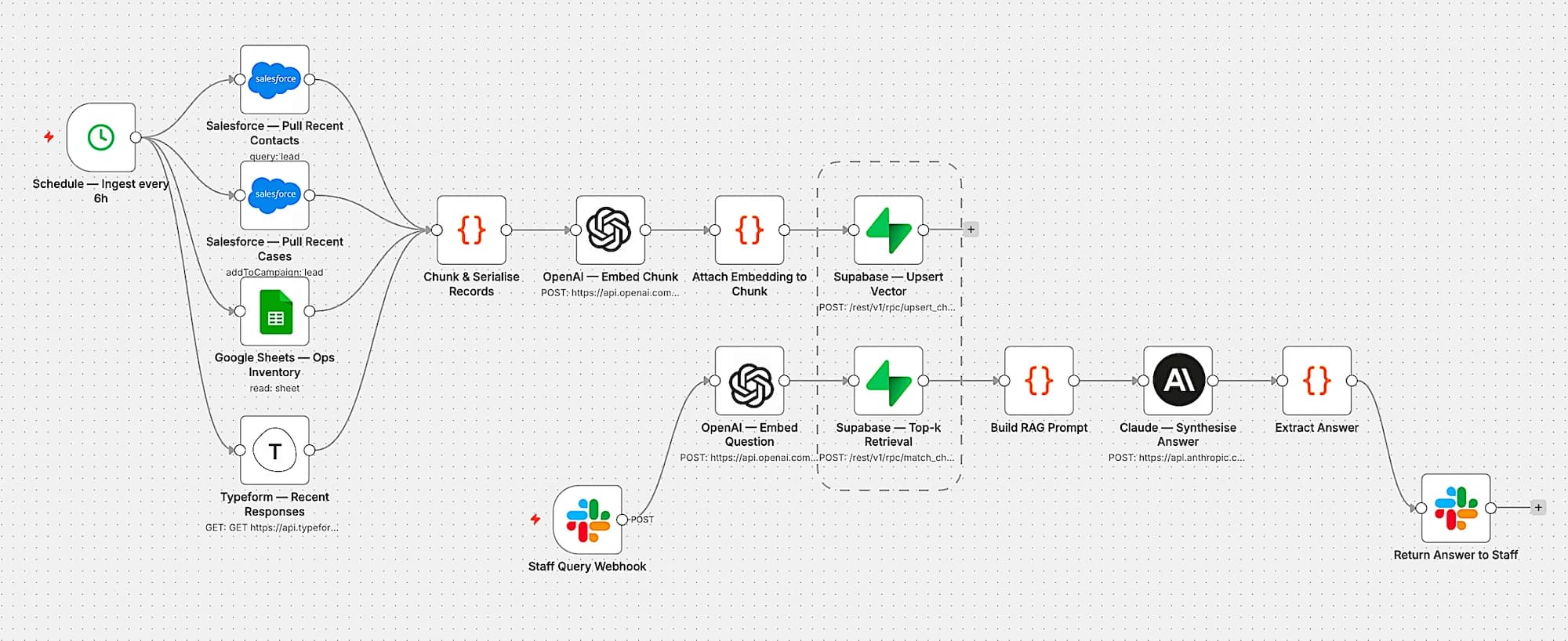
The n8n + RAG architecture closes that gap in six steps:
- Pull from all four sources on a schedule
- Chunk and serialise records into 400-character segments with overlap
- Embed each chunk via OpenAI
text-embedding-3-small - Store vectors in Supabase pgvector (vector store)
- Staff member asks a question in plain language via Slack
- Top-k similarity retrieval surfaces relevant chunks from vector store → Claude synthesises the answer → response via Slack
This is the revenue intelligence layer. In enterprise B2B, this is what good CRM hygiene plus a signal layer produces. In a nonprofit, it produces the same thing: faster, better-quality decisions at every point in the stakeholder pipeline.
Where Closmore's Framework Applies
Closmore was built for B2B enterprise sales: signal-driven qualification, context-aware outreach, and pipeline discipline over volume. The core argument — that more activity doesn't produce more revenue, but better decision-making does — maps directly to the nonprofit GTM problem.
The 3D Qualifier (Demand, Dollars, Dynamics) translates cleanly the nonprofit equivalent:
- Demand → Family eligibility criteria, partner approval status
- Dollars → Donor giving history, grant cycle timing
- Dynamics → Other charities serving the same referral network
The "volume trap" — the tendency to scale activity instead of improving qualification — is precisely what Furniture Bank is trying to escape. They're not trying to send more emails. They're trying to make each donor relationship, each partner referral, each corporate outreach count more.
The SalesOS principle — stop being the hero, start being the orchestrator — is also the right frame for nonprofit AI adoption. The CEO is not the hero. The pipeline is. The staff member with access to a RAG bot answering "which donors lapsed in the last 90 days in Etobicoke" is closing a gap that used to require a data analyst and a half-day.
What Kershaw's Hiring Process Actually Proved
The second post in the series is the more important one for GTM thinkers.
Kershaw designed a pitch brief — Stage 2 of the application — that was "role-specific and operationally detailed." It asked candidates to build something real. The people who stood out:
- Named five AI tools with specific daily use cases, not just tool names
- Described timed production processes (60–75 minutes, start to finish)
- Built a pipeline where meeting recordings were auto-transcribed, fed to Claude, structured into fix documents, implemented through Claude Code, and human reviewed before shipping
- Submitted a GitHub repo with a data dictionary, synthetic dataset, working file, and organized submission folder
This is exactly what a strong enterprise sales demo looks like. The candidate who shows up with a working prototype beats the candidate who describes the prototype they plan to build. The nonprofit hiring manager, in this case, designed a process that selected for the same signal a good sales leader selects for: proof over promise.
The talent isn't missing. The infrastructure to find it is.
The Broader Argument
Nonprofits are not behind for lack of ambition. They're behind because they've been working without GTM infrastructure, no pipeline visibility, no signal layer, no qualification discipline, in a sector that rewards relationship and mission over process.
AI changes the math. The n8n + RAG architecture above isn't theoretical. Every component is available, open-source or low-cost. Facilitated by programming scripts, they are integrable with the stack Furniture Bank already runs. The coordination tax can be reduced to near zero. The referral pipeline can move at the speed of a form submission. The staff intelligence layer can make every member of the team as data-capable as the best analyst.
What's required isn't a large team or a large budget. It's pipeline thinking applied to a mission context.
Furniture Bank is not asking whether nonprofits should adopt AI. They're answering it.
This case study draws on public posts by Dan Kershaw published on Substack in March and April 2026. Furniture Bank is a Toronto-based social enterprise. This analysis was produced by Closmore to explore how B2B GTM frameworks apply to nonprofit donor and partner pipelines.
Closmore (closmore.com) is an AI-powered Sales OS for B2B enterprise teams. If you lead a nonprofit and want to think through your GTM architecture, reach out.
Ready to Architect Your Sales and GTM Pipeline?
I do not sell "sales tools." I architect GTM and Sales systems that turn stalled enterprise deals into predictable revenue.
If you are a Founder or GTM Leader tired of "firefighting" and ready to build a system that actually scales, let's talk.
If you have a high-stakes pipeline with recurring "Sales Silence Traps," or would like to audit your existing sales pipeline system with the Closmore SalesOS framework, I would like to show you how we can re-engineer your deal flow.